
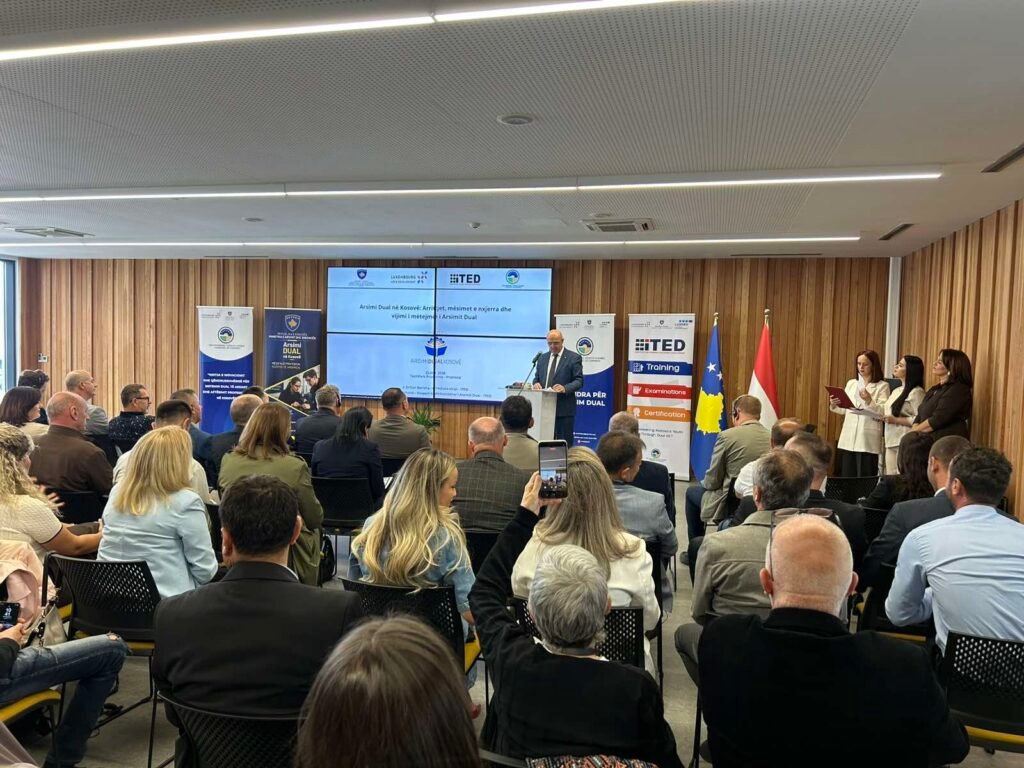
An Important Phase of Dual VET Education in Kosovo Comes to an End
The completion of the 2025–2026 school year marks an important phase in the continued development of Dual Vocational Education and Training (Dual VET) in Kosovo.
The achievements of the year were presented during the closing conference “Strengthening Dual Education in Kosovo: Achievements, Lessons Learned and the Way Forward”, bringing together representatives of national institutions, the private sector, development partners, vocational schools and other stakeholders involved in the development and implementation of Dual VET.
The conference also marked the completion of the project “Examination and Certification of Dual VET Education Students for the 2025–2026 School Year”, implemented by ITED – Institute for Training and Economic Development, in cooperation with the Kosovo Chamber of Commerce, with the support of the project “Skills for Sustainable Employment in Kosovo”, funded by the Government of Luxembourg and implemented by the Ministry of Education and Science and LuxDev – Luxembourg Development Cooperation Agency.
The project represented one component of a broader reform process aimed at developing, strengthening and institutionalizing Dual VET in Kosovo.
From a Pilot Initiative Towards a Broader System
The development of Dual VET in Kosovo has taken place over a relatively short period of time.
The system started in 2022 as a pilot initiative involving only 4 vocational schools and 4 occupational profiles. Through successive phases of development, standardization, capacity building and expansion, Dual VET has grown into a broader system involving vocational schools, students, enterprises and public institutions across Kosovo.
By the 2025–2026 school year, the system had expanded to:
- 32 vocational schools
- 18 municipalities
- 16 occupational profiles
- Around 2,300 students
- Around 100 partner enterprises
- 32 Trainers of Trainers (ToTs)
- 192 Vocational Practice Teachers trained
- Around 450 pre-qualified in-company instructors
This development reflects the gradual strengthening of cooperation between vocational education institutions and the private sector, with workplace learning becoming an increasingly important component of students’ professional development.
Strengthening Assessment and Certification
An important part of the development of Dual VET has been the establishment of a structured assessment, examination and certification system.
The system has introduced procedures for written, practical and oral examinations, together with trained examiners and examination commissions.
During the 2025–2026 school year:
- 225 examiners were trained and certified
- 87 examination commissions were established
- Written, practical and oral examinations were organized
- 480 students successfully completed the certification process, from 27 vocational schools and across 12 vocational profiles
The 480 students certified during the 2025–2026 school year represent the second major group of Dual VET students to complete the certification process.
Together with the 90 students certified during the 2024–2025 school year, a total of 570 students have been certified through the Dual VET system during the two school years.
This represents an important step in establishing and operationalizing a structured national assessment and certification process within Dual VET.
A Collaborative Implementation Process
The successful implementation of the examination and certification process required close coordination among a wide range of stakeholders.
The process brought together:
- The Department for Vocational Education and Training (DVET) within the Ministry of Education and Science;
- Kosovo Chamber of Commerce;
- LuxDev – Luxembourg Development Cooperation Agency;
- Vocational school principals and teachers;
- Trainers of Trainers;
- Examiners;
- Partner enterprises;
- Students;
- Municipal education structures and other relevant stakeholders.
During the 2025–2026 examination cycle, practical examinations were monitored and supported in 37 classes across 23 vocational schools, while written examinations were supported in 50 classes across 27 schools.
The process provided an important opportunity to assess the professional competencies acquired by students through both school-based learning and practical training in enterprises.
Lessons Learned
The implementation of the examination and certification process also provided important experience for the further development of the Dual VET system.
The first nationwide implementation highlighted the importance of:
- clear examination procedures and responsibilities;
- well-prepared and certified examiners;
- effective coordination between schools and enterprises;
- consistent quality assurance mechanisms;
- stronger institutional ownership;
- continuous feedback from students, teachers, enterprises and other stakeholders.
The lessons learned from the 2025–2026 examination cycle provide a basis for further improving the assessment and certification system and strengthening its implementation in future school years.
What Comes Next?
The completion of the current phase represents not an end point, but an opportunity to consolidate what has been developed and further strengthen the system.
The next phase should focus on strengthening institutional ownership, continuously improving quality assurance, strengthening cooperation with the private sector and expanding Dual VET where there is sufficient demand and implementation capacity.
Particular attention should also be given to the continuous professional development of teachers, company instructors and examiners, as well as to the further development of occupational profiles in line with labour market needs.
The continued involvement of national institutions and the private sector will be essential for ensuring that the structures and mechanisms developed through the reform become sustainable components of Kosovo’s national TVET system.
A Shared Achievement
The progress achieved through Dual VET is the result of the combined efforts of many institutions, professionals, schools, enterprises, teachers and students.
Sincere appreciation goes to the Department for Vocational Education and Training (DVET) within the Ministry of Education and Science, the Kosovo Chamber of Commerce, LuxDev, vocational schools, school principals, teachers, ToTs, examiners, partner enterprises and students for their cooperation and commitment throughout the process.
Special recognition goes to the Embassy of the Grand Duchy of Luxembourg in Kosovo and all institutional and development partners for their continued support to the development of Dual VET in Kosovo.
ITED also expresses its appreciation to its team and experts who contributed throughout the process, supporting the development of the system and translating the planned activities into concrete results at school and enterprise level.
Looking Ahead
The experience gained through the development and implementation of Dual VET demonstrates the importance of connecting vocational education with the real needs of the labour market.
The objective for the coming years is clear: to continue building a quality, sustainable and increasingly institutionalized Dual VET system, based on strong partnerships between vocational schools, enterprises and public institutions.
The achievements of the 2025–2026 school year, together with the experience gained since the launch of Dual VET, provide an important foundation for the next phase of the reform.
Towards a stronger future for Dual Vocational Education and Training in Kosovo.
About the Initiative
The project “Examination and Certification of Dual VET Education Students for the 2025–2026 School Year” was implemented by ITED – Institute for Training and Economic Development, in cooperation with the Kosovo Chamber of Commerce, with the support of the project “Skills for Sustainable Employment in Kosovo”, funded by the Government of Luxembourg and implemented by the Ministry of Education and Science and LuxDev – Luxembourg Development Cooperation Agency.
The initiative forms part of the broader efforts to strengthen Dual VET in Kosovo and to establish a stronger connection between vocational education, workplace learning and labour market needs.
Copyright & Attribution
This article is a publication of ITED – Institute for Training & Economic Development. It may be freely reproduced, shared and used, provided that ITED is clearly acknowledged as the source and producer of the content.


